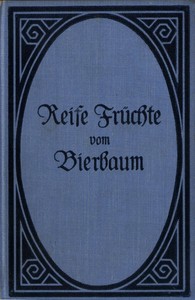
Reife Früchte vom Bierbaum by Otto Julius Bierbaum
Let's clear something up first: this isn't a novel. 'Reife Früchte vom Bierbaum' is a collection. Think of it as Bierbaum's literary scrapbook from around the 1890s. It's packed with lyric poems, short prose vignettes, witty epigrams, and playful observations. There's no single narrative thread. Instead, you jump from a beautiful, romantic poem about nature to a satirical jab at pretentious art critics, followed by a melancholic reflection on a Berlin street corner.
The Story
Since there's no plot, the 'story' is the world Bierbaum shows us. He was a key figure in the German Jugendstil (Art Nouveau) and early modernist scenes. His pieces act like snapshots of that era. You get the aesthetic beauty the movement loved—the focus on flowers, delicate emotions, and refined style. But you also get the other side: his irony and his eye for the ridiculous. He writes about bohemian life, the thrill of new ideas, and the quiet disappointments of everyday existence. Reading it is like flipping through a smart, slightly jaded friend's journal from a fascinating historical moment.
Why You Should Read It
I loved it for its voice. Bierbaum doesn't preach or overwrite. He's conversational, even when writing poetry. His humor holds up surprisingly well—his eye for social awkwardness is timeless. The collection feels intimate and immediate. You're not getting a historian's summary of the 1890s; you're getting the raw sensory experience of it from someone who was there, complaining about fashions and celebrating a perfect sunset in the same breath. The contrast between his beautiful, formal verses and his cheeky, informal prose is a big part of the fun. It shows a man not confined by one style, but playing with all of them.
Final Verdict
This is a perfect book for mood readers and literary explorers. If you need a fast-paced plot, look elsewhere. But if you enjoy dipping into short, evocative pieces—the kind you read one or two of with your morning coffee—this is a treasure. It's especially great for anyone interested in the roots of modern European literature, the fin-de-siècle period, or just the musings of a genuinely interesting mind. It's a small, ripe fruit from a distant time that still has a lot of flavor.
There are no legal restrictions on this material. You do not need permission to reproduce this work.