About 334 minutes
Eight Cousins — Text and Context
Young Readers Enchanted Adventures
76,638 recorded words. 14 minutes difference from this book's estimate.
View Gutenberg source #2726
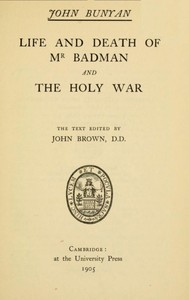
The source record for Life and Death of Mr. Badman — Story, Setting & Ideas measures this digital text at 79,869 words, 5 hr 48 min estimated reading time, and 9 detected text sections.
The text analysis averages about 24.5 words per sentence, while the detected sections provide another way to judge how the source is divided.
Project Gutenberg metadata also associates the work with “Conduct of life -- Fiction,” connecting these edition facts with the source record’s subject description.
Explore this collection
These alternatives are selected using recorded categories and estimated reading time.
About 334 minutes
Young Readers Enchanted Adventures
76,638 recorded words. 14 minutes difference from this book's estimate.
View Gutenberg source #2726About 333 minutes
Young Readers Enchanted Adventures
76,543 recorded words. 15 minutes difference from this book's estimate.
View Gutenberg source #1858About 301 minutes
Young Readers Enchanted Adventures
69,035 recorded words. 47 minutes difference from this book's estimate.
View Gutenberg source #2381Search stored excerpts and compare books → Choose by your preferences →
Choices use stored catalog measurements. Estimates vary with reading speed. A shared category is a catalog label, not a claim that two books have the same argument or literary quality.
Search reads excerpt text stored with this catalog and links to its associated Gutenberg record. The connection is stored in the site database; this tool does not recheck that every excerpt is word-for-word identical to that external record. Excerpt search does not cover every chapter and does not verify historical publication dates.
Catalog snapshot checked: 2026-09-25. Coverage: 93 public books, 93 available source excerpts.
Read the complete public-domain text at its original source.
Read on Project GutenbergJohn Bunyan's Life and Death of Mr. Badman opens with a preface positioning the work as a companion to The Pilgrim's Progress, yet its form diverges sharply from allegory. Bunyan adopts a dialogue between Mr. Wiseman and Mr. Attentive, a structure borrowed from Arthur Dent's The Plaine Man's Pathway to Heaven. The excerpts reveal a sustained focus on economic calamity as divine judgment: a man reduced to a morsel of bread is counseled to see his poverty as the fruit of sin. Bunyan's voice is direct, homiletic, and unflinching, urging the afflicted to 'quietly lye down' under God's hand. The text's diction—'Snake in the grass,' 'Worm in the gourd'—draws on biblical imagery to frame material loss as spiritual discipline.
The dialogue form allows Bunyan to dissect moral failure through question and answer. Mr. Wiseman, the instructor, does not merely narrate but presses his listener to self-examination. When addressing a man in debt, he prescribes three steps: ask forgiveness, surrender all possessions, and offer one's body to creditors. This legalistic precision mirrors the Puritan casuistry of the period. The exchange is not dramatic but didactic; Mr. Attentive's role is to draw out practical counsel. Bunyan's sentences are often imperative—'Let him heartily, and unfeignedly ask them forgiveness'—creating a tone of urgent moral instruction. The dialogue lacks the allegorical figures of The Pilgrim's Progress; instead, it presents a realistic, if stylized, conversation about sin and restitution.
Bunyan treats financial collapse as a providential event demanding spiritual interpretation. The speaker insists that a man brought to 'a morsel of Bread' must assume it is 'the fruit of some sin.' He lists possible causes: an over-attachment to the world, neglect of religion in the family, or some hidden transgression—'a Snake in the grass.' The remedy is not practical advice but humility and submission. Bunyan's language is concrete: 'strip himself to his raiment,' 'not keep a Ring, a Spoon.' The poor are said to be less capable of sinning against God than the rich, a paradox that inverts worldly values. This section reveals Bunyan's conviction that material hardship is a pedagogical tool, designed to wean the soul from earthly trust.
Bunyan acknowledges the difficulty of his counsel: 'this is an hard Chapter, and therefore I do not expect that many should either read it with pleasure, or desire to take my counsel.' This rare moment of self-awareness highlights the tension between his rigorous theology and human reluctance. The text then lists four encouragements for the afflicted: lying down under God's hand, the blessings of a low condition, clearer sight of providence, and the possibility that poverty leads to spiritual riches. Bunyan cites Job's example—'The Lord giveth, and the Lord hath taken away'—to model acceptance. The prose is rhythmic, with numbered points that mimic sermon structure. The author's voice is both pastoral and stern, offering comfort only within a framework of unyielding moral accountability.
Bunyan's word choices carry theological weight. 'Broken man' describes the debtor, linking financial ruin to spiritual contrition. 'Preventing mercy' suggests grace that forestalls greater evil. The phrase 'hard Commons' evokes meager rations, contrasting with 'full and fat pasture' of former prosperity. Bunyan avoids abstract nouns; sin is a 'Snake,' a 'Worm,' something to be 'found out.' The repeated imperative 'let him' imposes a rhythm of duty. Even the structure—numbered points, biblical citations, direct address—reflects a preacher's craft. The excerpts show Bunyan using plain, forceful language to make moral categories tangible. His voice is consistent: urgent, authoritative, and unapologetically demanding, expecting the reader to measure their life against his exacting standards.
Readers approaching Life and Death of Mr. Badman should attend to its dialogic structure and the way Bunyan uses economic crisis to explore sin and repentance. The text rewards careful reading of its biblical allusions and numbered counsels. Unlike allegory, this work demands that the reader engage with moral argument rather than narrative symbol. Bunyan's voice is consistent throughout: direct, homiletic, and unyielding. The book offers a window into Puritan practical theology, where every circumstance—even bankruptcy—becomes a sign of divine purpose.
Reading about Mr. Badman’s quiet unraveling, I remembered my own grandfather’s ledger book, each debt a small confession he never spoke aloud. That same weight of unspoken reckoning visited me once in Some Christmas Stories — Text and Context, where joy feels borrowed, precarious, like tinsel on a branch about to snap. Both books hold their truths gently, letting them surface slowly.
A brief reflection can help important ideas stay with you longer.