
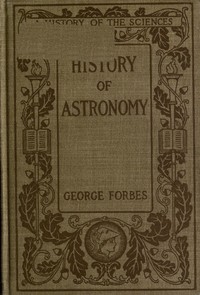
History of Astronomy by George Forbes
George Forbes's History of Astronomy does something brilliant: it makes the history of science feel like an adventure story. He doesn't just tell you what happened; he shows you how it happened, step by stumbling step, through the eyes of the people who lived it.
The Story
The book starts at the very beginning, with ancient civilizations using the stars to track time and navigate. Forbes then walks us through the major turning points. We see the Greek philosophers making bold guesses about a sun-centered universe, only for that idea to be lost for centuries. We follow the painstaking work of medieval Arabic scholars who preserved and refined astronomical knowledge. The story really picks up with the Renaissance, where figures like Copernicus, Tycho Brahe, Kepler, and Galileo clash with established beliefs, using new tools like the telescope to challenge everything society thought it knew. Forbes carries the narrative right up to his own time, showing how Newton's laws of motion and gravity finally provided a universal framework, setting the stage for modern astrophysics.
Why You Should Read It
What makes this book special is Forbes's clear respect for the process of science. He celebrates the successes but is just as interested in the wrong turns and dead ends. You see how progress often depended on a single curious person stubbornly questioning the obvious. It’s incredibly grounding. In an age where we get answers from our phones in seconds, this history reminds us that our understanding of the cosmos was hard-won over millennia. It makes you appreciate the night sky in a whole new way. You're not just looking at stars; you're looking at the same puzzle that captivated and frustrated the greatest minds in history.
Final Verdict
This is the perfect book for anyone with a spark of curiosity about how we know what we know. It's for the casual stargazer who wants to know the stories behind the constellations, the history fan interested in the intellectual battles of the past, and the science reader who enjoys seeing the human side of discovery. While it was written over a century ago, Forbes's clear, narrative-driven style keeps it engaging. Just be ready for a few outdated terms (it is a history book, after all!). If you want a fascinating, human-centered tour of our quest to understand the universe, this classic is still a wonderful guide.
This historical work is free of copyright protections. It is available for public use and education.
Kenneth Lee
1 year agoVery helpful, thanks.
Elijah White
2 years agoI started reading out of curiosity and it manages to explain difficult concepts in plain English. Highly recommended.
Matthew Thompson
7 months agoAs someone who reads a lot, it provides a comprehensive overview perfect for everyone. One of the best books I've read this year.
Mason Brown
1 year agoHaving read this twice, the arguments are well-supported by credible references. Exactly what I needed.








Margaret Miller
1 year agoSolid story.