
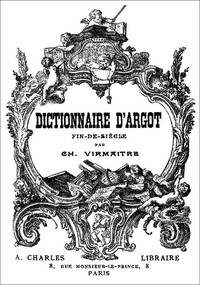
Dictionnaire d'argot fin-de-siècle by Charles Virmaître
Okay, let's clear this up first: this isn't a story with a plot. There's no hero's journey. Instead, Charles Virmaître's dictionary is the story of a city told through its words. Published at the very end of the 19th century, it captures Paris in a moment of huge change. The entries are the characters—each slang term is a little snapshot of life.
The Story
Virmaître, a journalist with a nose for the gritty side of town, spent years collecting the language of the streets. He compiled thousands of terms. You look up a word like "mouche" (literally "fly") and find out it meant a police informant. "Bouffer" meant to eat, but with a rough, hungry edge we don't get from "manger." The book organizes this chaotic, living language into something you can browse. The 'plot' is you, the reader, piecing together a world from these fragments. You start to see the concerns of everyday people: dodging the cops ("la rousse"), finding a place to sleep ("le pieu"), making a living by any means necessary. It's the ultimate insider's guide, written before insider guides were a thing.
Why You Should Read It
This book completely changed how I see historical periods. We often get the polished, official version. This is the opposite. The language is alive, clever, and often desperate. It’s full of humor and defiance. Reading it, you feel the energy of a city speaking in code. Virmaître doesn't judge; he reports. That gives the book its power. You're not getting a professor's analysis—you're getting a front-row seat. It makes that era feel immediate and real, not just a series of dates and paintings.
Final Verdict
Perfect for anyone obsessed with the hidden layers of history, true crime enthusiasts curious about the old underworld, or writers looking for authentic voices. If you love Paris, this is a must-read. It’s also fantastic for language nerds who enjoy seeing how words evolve from the shadows into common use. A word of caution: it's a dictionary, so dip in and out. Don't try to read it cover-to-cover. Keep it on your shelf, open it at random, and let 1890s Paris talk to you for five minutes. You'll be hooked.
This historical work is free of copyright protections. It is available for public use and education.
Ava Ramirez
1 year agoThis is one of those stories where the pacing is just right, keeping you engaged. Exceeded all my expectations.
Dorothy Miller
1 year agoLoved it.




James Brown
8 months agoIt’s refreshing to see such a high standard of digital publishing.